Soy Dangers

Confused About Soy? Soy Dangers Summarized

From an article by the Weston A. Price Foundation

Click here for full article including references: Soy Alert

  • High levels of phytic acid in soy reduce assimilation of calcium, magnesium, copper, iron and zinc. Phytic acid in soy is not neutralized by ordinary preparation methods such as soaking, sprouting and long, slow cooking. High phytate diets have caused growth problems in children.
  • Trypsin inhibitors in soy interfere with protein digestion and may cause pancreatic disorders. In test animals soy containing trypsin inhibitors caused stunted growth.
  • Soy phytoestrogens disrupt endocrine function and have the potential to cause infertility and to promote breast cancer in adult women.
  • Soy phytoestrogens are potent antithyroid agents that cause hypothyroidism and may cause thyroid cancer. In infants, consumption of soy formula has been linked to autoimmune thyroid disease.
  • Vitamin B12 analogs in soy are not absorbed and actually increase the body’s requirement for B12.
  • Soy foods increase the body’s requirement for vitamin D.
  • Fragile proteins are denatured during high temperature processing to make soy protein isolate and textured vegetable protein.
  • Processing of soy protein results in the formation of toxic lysinoalanine and highly carcinogenic nitrosamines.
  • Free glutamic acid or MSG, a potent neurotoxin, is formed during soy food processing and additional amounts are added to many soy foods.
  • Soy foods contain high levels of aluminum which is toxic to the nervous system and the kidneys.

Continue reading “Soy Dangers”

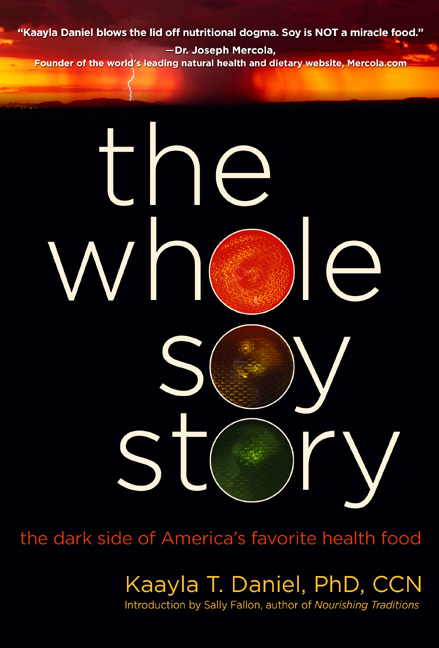
Research Reminder #9 Read “The Whole Soy Story”

For the author’s website, visit www.wholesoystory.com

Written by:

Kaayla T. Daniel, PhD, CCN, is THE WHOLE NUTRITIONIST®. She earned her PhD in Nutritional Sciences and AntiAging Therapies from the Union Institute and University in Cincinnati, is board certified as a clinical nutritionist (CCN) by the International and American Association of Clinical Nutritionists in Dallas and is a member of the Board of Directors of the Weston A. Price Foundation. As a clinical nutritionist, she specializes in digestive disorders, women’s reproductive health issues, infertility, and recovery from vegetarian and soybased diets.

Dr. Daniel is the author of The Whole Soy Story: The Dark Side of America’s Favorite Health Food (New Trends, March 2005), which has been endorsed by leading health professionals, including Kilmer McCully MD, Doris J. Rapp MD, Jonathan V. Wright, MD, Russell Blaylock, MD, Larrian Gillespie, MD, Joseph Mercola, OD, Debra Lynn Dadd and Larry Dossey, MD, who called it “science writing at its best.”

Comfortable in front of radio, television and live audiences, Dr. Daniel has been “media trained” by Joel Roberts, formerly cohost of KABC, Los Angeles’ most highly rated talk radio program, who calls her a “class A entertainer” and a “naughty nutritionist” with the ability to outrageously and humorously debunk nutritional myths.” Dr. Daniel has been extensively quoted in major newspapers and magazines, including the San Francisco Chronicle, Washington Post, USA Today, Toronto Globe & Mail, Glamour, Utne Reade and Alternative Medicine, and has appeared as a guest on NPR’s People’s Pharmacy, the Discovery Channel’s Medical Hotseat and ABC’s View from the Bay. Online her book has been featured prominently on http://www.mercola.com , the world’s leading natural health and dietary website. She has also appeared as an expert witness before the California Public Safety Committee and the National Institute for Environmental Health Sciences.

Soy’s Affect on Male Fertility

Soy Foods Lower Sperm Count

October 17, 2007

by Kaayla T. Daniel, Phd

Soy Expert Links New Research to America’s Infertility Epidemic

Washington, DC – Estrogenlike compounds in soy foods can lower sperm count according a Harvard School of Public Health research presented at the 63rd Annual Meeting of the American Society for Reproductive Medicine. The report, by Jorge Chavarro, MD, ScD, bolsters concerns expressed by scientists, doctors and nutritionists who have warned that soy can adversely affect male fertility. America is in the midst of an epidemic of infertility, according to Kaayla T. Daniel, PhD, CCN, author of The Whole Soy Story: The Dark Side of America’s Favorite Health Food. “Soy is heavily marketed as a health food, despite adverse effects on male fertility. Men who eat soy foods and drink soy milk are less likely to father children and more likely to experience loss of libido. This latest study shows lowered sperm concentration. Other researchers have linked soy consumption to poor sperm quality as well as lowered testosterone levels.” Continue reading “Soy’s Affect on Male Fertility”

Drinks + Bone Health

By Madeline Behrendt, D.C.

Back in the kitchen, some quick comments on what we reach for and how they affect bones:

COFFEE – Chemically can create a negative calcium balance. Coffee is also one of the crops most heavily sprayed with pesticides and questions are raised how those hormones can affect bone health. People actually do live without coffee, if that sounds unbearable, many also try organic, drink less or boost up other bone builder factors.

MILK – Innate has designed us to become lactose intolerant (3 of 4 adults), let’s listen. Milk is NOT a preferred calcium source, in fact after 3 generations of milk promotion, osteoporosis has reached epidemic proportions in the West, while in countries where it is not consumed, it hardly exists. Calcium can be found in many user-friendly sources, try there.

SODA – Bubbles and bones don’t mix, studies show it leeches calcium and children consuming soda had low blood calcium levels. Another study reported DOUBLE the urinary calcium loss in teens 13-19 (remember those are the years spent building towards peak bone density.)

JUICE – Natural is best, when calcium is artificially encouraged (as in fortified) reports indicate calcium can be deposited in the wrong place (cardiovascular, kidneys, female organs.)

SHAKE – can be a great start to the day, depending upon what is put in it. Good stuff: organic fruits, almond or other nut butters, rice milk. Have fun experimenting.

WATER – One of the best ways to start the day is with a glass of clean (filtered from chemicals/hormones) water, hot or cold, with lemon. Then on to a good breakfast.

Our Lady Bones

Estrogen, Hormones, Osteoporosis and Bones: The Herstory of Bones

We demand and assume our bones will last our lifetime, yet may take them for granted or treat them like a rental car. Care or carelessness – the results are ours to choose. 

July 25, 2000

By Madeline Behrendt, D.C.

It’s 6:30 a.m. Eyes open to the sun painting a new canvas over the foothills. Ears alert to the sound of morning feet padding through the hallway, destination locked in. The body moves, sleep is surrendered as the commitment from horizontal to vertical is made. Feeling anticipation, the stomach shifts all focus towards the kitchen. Arms extend, fingers grasp, mouth waits… Coffee? Milk? Soda? Juice? Shake? Water? So starts a new day in the ‘Herstory’ of bones.

Bones are undercover dutiful workers, silhouettes barely visible; yet home to ceaseless invisible activity. They are a part of a passive subsystem, not able to move us nor themselves, yet our entire physical being depends on them for strength, support and protection. They are also home to part of our precious immune system.

Women and bones are linked in our culture, although men can also experience changes in bone health. During the different stages of a woman’s lifecycle, Innate changes the ratio of (new bone being built)/(old bone being broken down) and choices made within the normal rhythm of the day can support or interfere with the potential Innate offers.

In addition to daily choices, because our body is designed to achieve peak bone density during our 30’s, timing is also a factor, and paying attention during the early years can influence whether or not our peak is achieved.

Nutrition. Beverages. Exercise. Elective Prescription Drugs. Hormones. BONE CHOICES. And choosing to remain subluxated offers potential consequences we can never neglect.

We demand and assume our bones will last our lifetime, yet may take them for granted or treat them like a rental car. Care or carelessness – the results are ours to choose.

In Womanculture as described by the Symptom/Disease/Prevention model, osteoporosis (or the fear of) receives a lot of attention, especially in regards to its suggested relationship to menopause, estrogen deficiency and bone density.

Looking at the view from Inside, rather than Outside, are reports that offer clarity: – Poor bone health during menopause is not automatically attributed to this lifecycle as studies show that osteoporosis can start many years prior to menopause (early care is important!.)

We are told we lose estrogen (creating the image of estrogen deficiency), but what loss? Innate resets our hormone levels – making what is appropriate for this lifecycle, and protects us from the effects of having too much of a hormone, who’s excess can lead to cancer.

Estrogen is NOT the bone builder hormone; reports indicate that progesterone (not progestin) is responsible for this function.

Low bone density does not define osteoporosis; they are not interchangeable terms, LBD is a factor that can contribute, but not guarantee OP, as additional factors weigh in.

As hormones are involved in bone health, hormonal drugs are heavily promoted, but their sales are vulnerable to self-sabotage as inevitable side effects surface. Like revolutionary soldiers, new drugs stand poised to replace them, ready for their 15 minutes of fame, spinning promises and information often culled from self-funded studies before they too are shot down. The Public is questioning the credibility of endless cycles of “miracle” drugs that can deliver “miracle” side effects. Miracles? Real miracles can come from above, down, inside, out.

Interference in bone health can seem silent, but the effects are very loud, as the most common first site of fracture due to osteoporosis is the thoracic spine, which protects and houses our nervous system. In my practice, women speak of watching their mom’s quality of life decline as her spine crumbled, they want to be educated and informed as to how to help their spine be healthy for the long run. I am committed to helping them and their daughters through subluxation-based care and teaching the benefits of the chiropractic lifestyle.

It’s 6:30 a.m. A new day is waiting. Start off AWEsome and subluxation-free.

——————–
Dr. Madeline Behrendt is the author of A Woman’s Experience/A.W.E.(TM) Reports On Women’s Health Topics.

Research Reminder #5: Hormones

Which foods have hormones (testosterone, estrogen) in them?

So far I’ve heard: Almonds and soy have estrogen, Walnuts have testosterone, Dairy, Meat, have hormones. And i just had a friend say she thinks sweet potatoes have hormones, but I looked up a quick bit on it and it’s not true unless we have labcoats in the kitchen… here’s what I found

This article also came up while looking for an image and looks interesting!