Soy Dangers

Confused About Soy? Soy Dangers Summarized

From an article by the Weston A. Price Foundation

Click here for full article including references: Soy Alert

  • High levels of phytic acid in soy reduce assimilation of calcium, magnesium, copper, iron and zinc. Phytic acid in soy is not neutralized by ordinary preparation methods such as soaking, sprouting and long, slow cooking. High phytate diets have caused growth problems in children.
  • Trypsin inhibitors in soy interfere with protein digestion and may cause pancreatic disorders. In test animals soy containing trypsin inhibitors caused stunted growth.
  • Soy phytoestrogens disrupt endocrine function and have the potential to cause infertility and to promote breast cancer in adult women.
  • Soy phytoestrogens are potent antithyroid agents that cause hypothyroidism and may cause thyroid cancer. In infants, consumption of soy formula has been linked to autoimmune thyroid disease.
  • Vitamin B12 analogs in soy are not absorbed and actually increase the body’s requirement for B12.
  • Soy foods increase the body’s requirement for vitamin D.
  • Fragile proteins are denatured during high temperature processing to make soy protein isolate and textured vegetable protein.
  • Processing of soy protein results in the formation of toxic lysinoalanine and highly carcinogenic nitrosamines.
  • Free glutamic acid or MSG, a potent neurotoxin, is formed during soy food processing and additional amounts are added to many soy foods.
  • Soy foods contain high levels of aluminum which is toxic to the nervous system and the kidneys.

Continue reading “Soy Dangers”

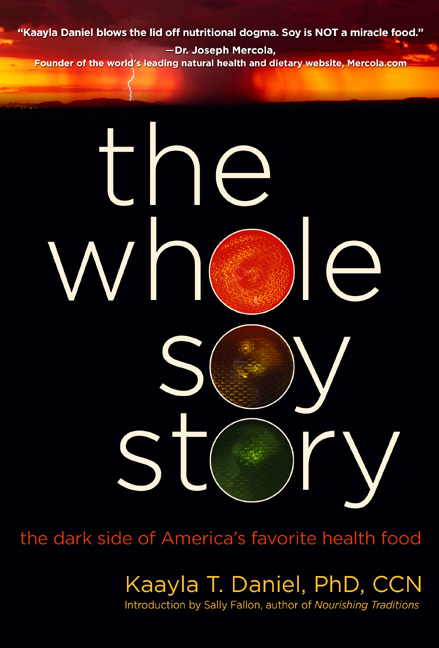
Research Reminder #9 Read “The Whole Soy Story”

For the author’s website, visit www.wholesoystory.com

Written by:

Kaayla T. Daniel, PhD, CCN, is THE WHOLE NUTRITIONIST®. She earned her PhD in Nutritional Sciences and AntiAging Therapies from the Union Institute and University in Cincinnati, is board certified as a clinical nutritionist (CCN) by the International and American Association of Clinical Nutritionists in Dallas and is a member of the Board of Directors of the Weston A. Price Foundation. As a clinical nutritionist, she specializes in digestive disorders, women’s reproductive health issues, infertility, and recovery from vegetarian and soybased diets.

Dr. Daniel is the author of The Whole Soy Story: The Dark Side of America’s Favorite Health Food (New Trends, March 2005), which has been endorsed by leading health professionals, including Kilmer McCully MD, Doris J. Rapp MD, Jonathan V. Wright, MD, Russell Blaylock, MD, Larrian Gillespie, MD, Joseph Mercola, OD, Debra Lynn Dadd and Larry Dossey, MD, who called it “science writing at its best.”

Comfortable in front of radio, television and live audiences, Dr. Daniel has been “media trained” by Joel Roberts, formerly cohost of KABC, Los Angeles’ most highly rated talk radio program, who calls her a “class A entertainer” and a “naughty nutritionist” with the ability to outrageously and humorously debunk nutritional myths.” Dr. Daniel has been extensively quoted in major newspapers and magazines, including the San Francisco Chronicle, Washington Post, USA Today, Toronto Globe & Mail, Glamour, Utne Reade and Alternative Medicine, and has appeared as a guest on NPR’s People’s Pharmacy, the Discovery Channel’s Medical Hotseat and ABC’s View from the Bay. Online her book has been featured prominently on http://www.mercola.com , the world’s leading natural health and dietary website. She has also appeared as an expert witness before the California Public Safety Committee and the National Institute for Environmental Health Sciences.

Soy’s Affect on Male Fertility

Soy Foods Lower Sperm Count

October 17, 2007

by Kaayla T. Daniel, Phd

Soy Expert Links New Research to America’s Infertility Epidemic

Washington, DC – Estrogenlike compounds in soy foods can lower sperm count according a Harvard School of Public Health research presented at the 63rd Annual Meeting of the American Society for Reproductive Medicine. The report, by Jorge Chavarro, MD, ScD, bolsters concerns expressed by scientists, doctors and nutritionists who have warned that soy can adversely affect male fertility. America is in the midst of an epidemic of infertility, according to Kaayla T. Daniel, PhD, CCN, author of The Whole Soy Story: The Dark Side of America’s Favorite Health Food. “Soy is heavily marketed as a health food, despite adverse effects on male fertility. Men who eat soy foods and drink soy milk are less likely to father children and more likely to experience loss of libido. This latest study shows lowered sperm concentration. Other researchers have linked soy consumption to poor sperm quality as well as lowered testosterone levels.” Continue reading “Soy’s Affect on Male Fertility”

Female Isolation not good for Boobies Cancer

I am currently living at my mom’s apartment in Los Angeles County, a place where cars are pivotal, and I am injured and can’t drive. Since arriving, Mom has become unable to drive as well. I am about 45 minutes outside of Los Angeles the city where my friends live. I also have an injured foot, so it hurts to walk. I feel increeedibly isolated. I can’t drive, bike, or walk. It’s a “catch 22″… I need to go to the doctor and acupuncturist so I’ll heal and be able to transport myself places, but I can’t transport myself to those places in order to heal.

I had a beautiful day with my Mama today though. She’s been suffering from a mental illness and for the past 10 months I felt like I wasn’t with her. She was here, but she was either depressed or manic and I couldn’t connect with her like I can with my true, sweet, awesome Mama. But today I could!!! And I felt much better.

I started doing physical therapy two days ago. It is the Egoscue Method. I have to do the exercises every single day and each week they will give me new ones. Although I feel isolated, when I am with friends, I often feel like I need to be working on healing. And then when I am here with Mama doing my physical therapy, I feel like I need to be with friends to work on emotional healing.

Continue reading “Female Isolation not good for Boobies Cancer”

One third of cancers are from what we eat & do

Diet and Physical Activity: What’s the cancer connection?

By The American Cancer Society

How much do daily habits like diet and exercise affect our risk for cancer? Much more than you might think. Increasingly, researchers agree that poor diets and sedentary lifestyles are among the most important contributors to cancer risk.

Fortunately, these are things we can control.

Control Your Weight

Except for quitting smoking, the best way to cut your risk of cancer is to achieve and maintain a healthy weight, to be physically active on a regular basis, and to make healthy food choices. The evidence for this is strong: Each year, about 550,000 Americans die of cancer; fully one-third of these deaths are linked to poor diet, physical inactivity, and carrying excess weight.

What’s a Healthy Weight?

One of the best ways to find out if you are at a healthy weight is to check your Body Mass Index (BMI), a score based on the relationship between your height and weight. Use our easy online BMI calculator to find out your score. To reduce your cancer risk, try to keep your BMI less than 25.

If you are trying to control your weight, a good first step is to watch portion sizes, especially of foods high in calories, fat, and added sugars. Try writing down what and how much you eat and drink for a week and see where you can cut down on portion sizes, cut back on some not-so-healthy foods and drinks, or both!

Be More Active

Watching how much you eat will help you control your weight. The other key is to increase the amount of physical activity you do. Being active helps reduce your cancer risk by helping with weight control, and can also reduce your risk by influencing hormone levels and your immune system.

More good news – physical activity helps you reduce your risk of heart disease and diabetes, too! So grab your tennis shoes and head out the door!

The latest recommendations for adults call for at least 30 minutes of intentional moderate to vigorous activity a day — this is over and above usual daily activities like using the stairs instead of the elevator at your office or doing housework — on 5 or more days per week. Even better, shoot for 45 to 60 minutes. For kids, the recommendation is 60 minutes or more a day.

Activities considered moderate are those that make you breathe as hard as you would during a brisk walk. This includes things like walking, biking, even housework and gardening. Vigorous activities generally engage large muscle groups and cause a noticeable increase in heart rate, breathing depth and frequency, and sweating.

Eat a Healthy Diet

Eating well is also important to improve your health and reduce your cancer risk. Take a good hard look at what you typically eat each day and incorporate the following suggestions to build a healthy diet plan for yourself:

Vegetables: You need to eat at least 5 servings of vegetables (including legumes) and fruits each day, especially those with the most color (a sign of high nutrient content). These foods are packed with vitamins, minerals, antioxidants, and many other substances that work together to lower risk of several cancers, including cancers of the lung, mouth, esophagus, stomach, and colon. Not only that, if prepared properly, vegetables and fruits are usually low in calories, so eating them in place of higher-calorie foods can help you control your weight.

Whole Grains: Aim for at least 3 servings of whole grains each day. There are easy ways to add whole grains to your diet — eat oatmeal at breakfast, choose whole-wheat bread or wraps for your lunchtime sandwich, whip up brown rice at dinner instead of white.

(*Ruth: Grains in their whole form are best for our bodies, like brown rice, steel-cut oatmeal, millet, barley, and quinoa.)

Processed Red Meats: Cutting back on processed meats like hot dogs, bologna, and luncheon meat, and red meats like beef, pork and lamb may help reduce the risk of colon and prostate cancers. These foods are also high in saturated fat, so eating less of them and eating them less often will also help you lower your risk of heart disease.

Cancer Risk Reduction in Our Communities

Adopting a healthier lifestyle is easier for people who live, work, play, or go to school in an environment that supports healthy behaviors. Working together, communities can create the type of environment where healthy choices become easy choices.

We all can contribute to those changes: Let’s ask for healthier food choices at our workplaces and schools. For every junk food item in the vending machine, ask for a healthy alternative. Support restaurants that support your desire to eat well by offering options such as smaller portion sizes, lower-calorie items, and whole-grain products. And let’s help make our communities safer and more appealing places to walk, bike, and be active.

The Bottom Line

One third of all cancer deaths are related to diet and activity factors. Let’s challenge ourselves to lose some extra pounds, to increase our physical activity, to make healthy food choices, and to look for ways to make our environments healthier places to live, work, and play.

Last Medical Review: 10/22/2009
Last Revised: 10/22/2009

www.cancer.org

Drinks + Bone Health

By Madeline Behrendt, D.C.

Back in the kitchen, some quick comments on what we reach for and how they affect bones:

COFFEE – Chemically can create a negative calcium balance. Coffee is also one of the crops most heavily sprayed with pesticides and questions are raised how those hormones can affect bone health. People actually do live without coffee, if that sounds unbearable, many also try organic, drink less or boost up other bone builder factors.

MILK – Innate has designed us to become lactose intolerant (3 of 4 adults), let’s listen. Milk is NOT a preferred calcium source, in fact after 3 generations of milk promotion, osteoporosis has reached epidemic proportions in the West, while in countries where it is not consumed, it hardly exists. Calcium can be found in many user-friendly sources, try there.

SODA – Bubbles and bones don’t mix, studies show it leeches calcium and children consuming soda had low blood calcium levels. Another study reported DOUBLE the urinary calcium loss in teens 13-19 (remember those are the years spent building towards peak bone density.)

JUICE – Natural is best, when calcium is artificially encouraged (as in fortified) reports indicate calcium can be deposited in the wrong place (cardiovascular, kidneys, female organs.)

SHAKE – can be a great start to the day, depending upon what is put in it. Good stuff: organic fruits, almond or other nut butters, rice milk. Have fun experimenting.

WATER – One of the best ways to start the day is with a glass of clean (filtered from chemicals/hormones) water, hot or cold, with lemon. Then on to a good breakfast.